

At a glance
Running a native systeme.io affiliate program suits solo course creators, coaches, and digital product merchants seeking to build an active promoter network without paying for standalone affiliate software. Because tracking links directly to your built-in funnels, email automation, and checkout pages, lean operations can avoid webhook maintenance and software bloat while managing partners from a single administrative dashboard.
In this guide
How Native Affiliate Tracking Operates in systeme.io
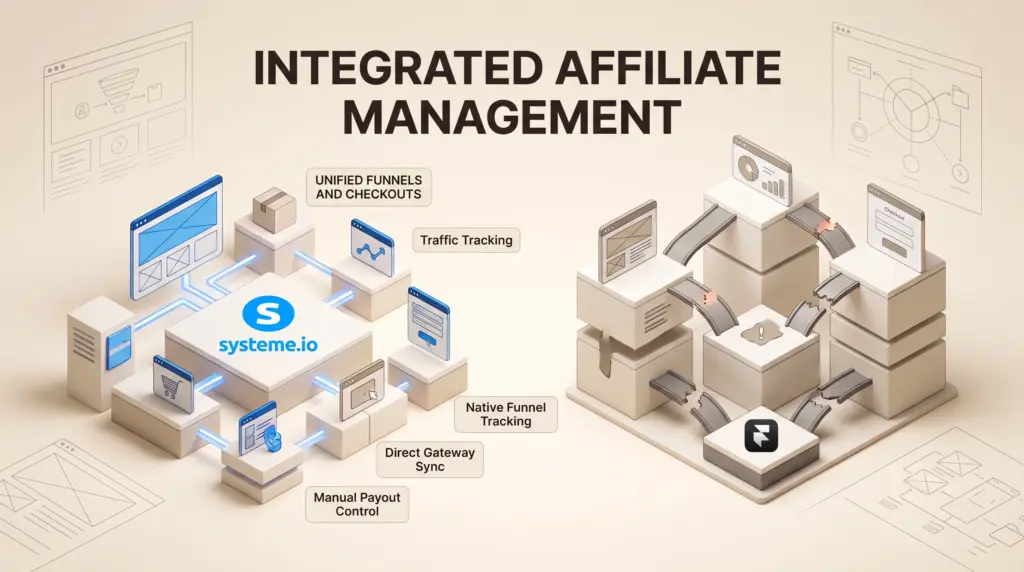
Managing partner referrals typically requires combining a dedicated tracking tool with external payment funnels and automation platforms. In contrast, the systeme.io affiliate program functionality is native to the core platform, meaning that your product catalog, checkout forms, customer database, and affiliate portals live within the exact same software environment.
When you activate your affiliate program, systeme.io automatically assigns a unique tracking identifier to your registered affiliates. As promoters share their assigned links to your sales funnels or opt-in pages, systeme.io logs the referral cookie and ties subsequent customer actions to that partner. If an incoming visitor buys a product, enrolls in a community, or joins a digital course, the transaction attributes cleanly inside your store ledger without relying on third-party webhook handshakes or external tracking pixels.
Because the affiliate mechanism operates on the checkout layer, transactions pass straight through your connected payment processors—such as Stripe, PayPal, Razorpay, or Flutterwave—without incurring platform transaction fees on any plan tier, based on systeme.io’s official pricing. This direct architecture removes the latency and sync mismatches common when connecting third-party affiliate apps to independent landing page builders.
Setting Up Your Affiliate Funnels and Partner Workflows
Constructing an affiliate engine inside systeme.io requires establishing three interconnected operational elements: the product offer, the affiliate onboarding sequence, and automated partner segmentation.
1. Connecting the Product and Offer Settings
Every digital product or course you host in systeme.io can be toggled to generate referral tracking. When configuring your sales funnel order pages, you determine payout schedules and payout delay periods directly within the offer dashboard. Payout delays allow sufficient time for your standard customer refund windows to close before payouts are marked as cleared in your financial logs.
2. Partner Onboarding and the Dedicated Affiliate Portal
Affiliates do not require access to your backend administrative account. Instead, systeme.io gives partners access to a dedicated front-end affiliate portal. Here, promoters can view:
- Their personalized referral links for your funnels, blogs, or lead magnets
- Real-time traffic statistics and confirmed sales conversions
- Payout history, pending approvals, and scheduled clearances
- Direct download links for promotional assets you choose to host on your account
Because systeme.io supports unlimited file storage on all plans, you can host affiliate swipe copy, banners, and video assets directly on your file servers without consuming third-party cloud hosting budgets.
3. Automating Partner Lifecycle Events
Using systeme.io’s native automation rules and workflows, you can trigger specific internal sequences when an affiliate brings in a customer. For example, you can automatically attach an account tag to affiliates who reach specific milestone numbers, enroll them in exclusive partner training funnels, or notify your internal administrative team via email when high-volume partners generate new sales.
Plan Capacities and Feature Allowances
One of the primary benefits of systeme.io is that affiliate management is available across the board, even on the baseline tier. However, overall platform allowances dictate how large an operation you can maintain before needing to upgrade.
| Plan Tier | Starting Price | Included Contacts | Sales Funnels | Included Courses | Sub-Accounts |
|---|---|---|---|---|---|
| Free | $0/month | 2,000 | 3 | 1 | No |
| Startup | $17/month | 5,000 | Unlimited | 5 | No |
| Webinar | $47/month | 10,000 | Unlimited | 20 | No |
| Unlimited | $97/month | Unlimited | Unlimited | Unlimited | Yes |
As documented on systeme.io’s official pricing page, the Free plan supports 1 affiliate program, 1 custom domain, and up to 2,000 audience contacts. For solo operators validating a single training program or digital product, this allows complete affiliate tracking at zero initial software overhead. To evaluate broader tier choices, review our guide to systeme.io pricing plans or read our breakdown of systeme.io Free vs. Startup when scaling your funnel volume.
Managing Payouts and Payment Processors
Affiliate commission records accumulate automatically inside your administrative dashboard based on successful checkouts. However, handling actual partner compensation requires understanding how systeme.io routes funds.
Platform checkouts link directly to your verified processing accounts, including Stripe and PayPal. When it comes time to distribute affiliate earnings, systeme.io aggregates cleared balances into downloadable payment logs or PayPal mass payout files. The platform does not hold escrow funds or automatically remit balance payments out of its own reserves; you remain the merchant of record responsible for initiating payout disbursements through your connected business accounts.
For operations serving global audiences, systeme.io provides integrations with regional payment options such as Mercado Pago and Xendit, along with cash-on-delivery tracking. Before onboarding an international partner network, confirm that your chosen payment rails can legally and efficiently disburse funds into your affiliates’ destination countries.
Key Operational Limitations to Consider
While an all-in-one architecture solves integration issues, managing a partner network inside systeme.io introduces notable functional constraints compared to dedicated enterprise tracking platforms:
- Manual Payout Execution: While balance ledgers generate inside your dashboard, payouts are not fully hands-off. Administrative staff must export payout logs and execute batch payments manually via PayPal or bank transfer.
- Basic Partner Portal Customization: The affiliate dashboard provides essential metrics and link tracking, but you cannot heavily recode or rebrand the portal interface beyond basic platform design options unless operating on custom white-label setups.
- No Automated Tax Compliance: The platform tracks earnings ledgers, but it does not collect, validate, or generate partner tax documentation (such as W-9 or 1099 reporting in the United States). Operators must manage tax compliance externally.
- Contact Limits Apply to Affiliates: Affiliates who create accounts or opt into your partner list are counted toward your account’s overall contact ceiling. High-volume affiliate recruitment campaigns can push a Free (2,000 contact limit) or Startup (5,000 contact limit) account into a higher paid subscription tier.
For teams seeking unified client management or agency-level sub-accounts alongside marketing tools, contrasting this setup with platforms like GoHighLevel can provide clarity; explore our HighLevel vs. systeme.io comparison for an analysis of agency and multi-account architectures.
Who Should Use systeme.io for Affiliate Management?
Solo Creators and Course Instructors
If you sell courses, digital templates, or coaching access through a few core funnels, systeme.io provides everything needed to incentivize students and peer creators to market your inventory. With zero platform transaction fees and all-in-one email delivery, you avoid the monthly recurring cost of maintaining separate affiliate portal subscriptions.
Bootstrapped Digital Product Sellers
Entrepreneurs launching digital assets on limited capital can run an entire customer and affiliate infrastructure on the Free plan up to 2,000 contacts. As product sales expand, moving to the $17/month Startup tier unlocks unlimited funnels while preserving existing partner referral tags.
When to Consider Dedicated Affiliate Networks Instead
If your business model depends on deep attribution models (such as multi-touch cross-device attribution), automated tax onboarding, or complex physical product inventory across multi-warehouse logistics, specialized affiliate tracking networks or enterprise affiliate SaaS will be better suited than an all-in-one funnel platform.
Next Steps
- Review your existing product pricing and funnel steps to ensure checkout conversion values are fully structured before generating partner links.
- Establish clear payout delays in your funnel settings to cover your customer return and refund windows.
- Connect your preferred merchant gateways (such as Stripe or PayPal) in your account settings and test end-to-end checkout tracking using a test referral link.
- Draft dedicated promotional resources, host them inside your systeme.io asset storage, and link them inside the welcome sequence of your affiliate onboarding funnel.
Sources and further reading
Research checked 2026-10-03. Product details can change.