

At a glance
HighLevel SaaS Mode is built for marketing agencies and software entrepreneurs seeking recurring software revenue without writing code. Available exclusively on the Agency Pro plan, it allows operators to package platform features into branded subscription tiers, provision client sub-accounts automatically upon payment, and rebill underlying telephony and email usage with a custom markup. For solo freelancers managing custom client retainers, lower-tier plans generally offer better capital efficiency.
In this guide
Understanding SaaS Mode and Client Provisioning
HighLevel operates primarily as a multi-tenant platform where agency operators create distinct workspaces called sub-accounts for their clients. While the entry-level Agency Starter plan caps operations at three sub-accounts and the Agency Unlimited plan allows manual sub-account creation without limits, neither tier enables automated software sales. To explore the broader structure of these foundational tiers, see our breakdown of HighLevel Starter vs. Unlimited.
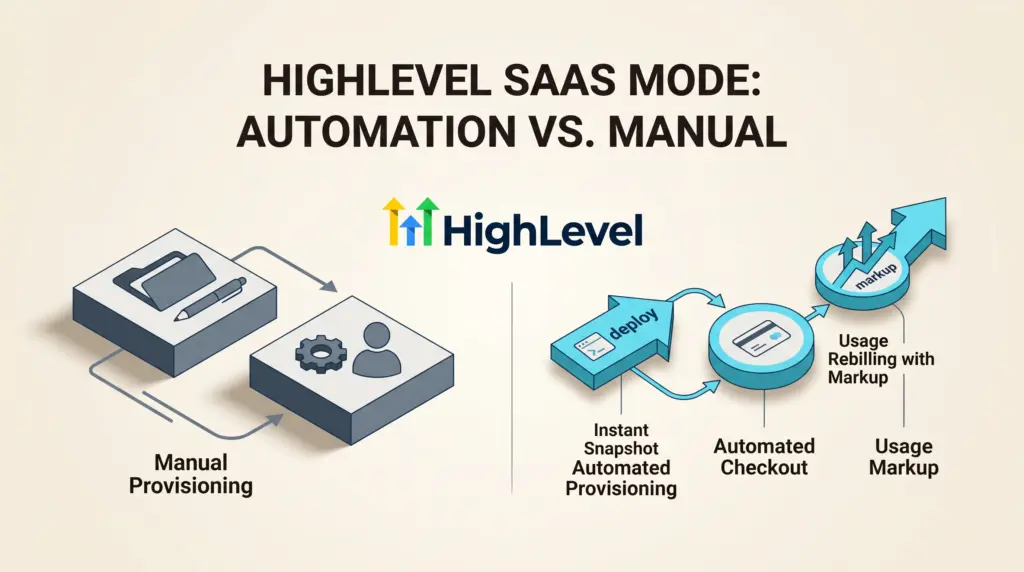
SaaS Mode changes this workflow by turning the platform into an automated software-as-a-service distribution engine. Instead of an agency administrator logging in to configure permissions, attach phone numbers, and manually copy asset templates, SaaS Mode ties client checkout directly to workspace provisioning. When an end customer signs up through a payment funnel on your agency site, HighLevel automatically creates the sub-account, applies your predefined industry snapshot—including pipelines, funnels, and workflows—and emails login credentials directly to the client under your agency branding.
This automated provisioning workflow removes administrative overhead. Freelancers scaling into boutique agencies can maintain operational consistency across dozens of accounts without dedicating billable hours to basic onboarding. For a deeper look at workspace architecture, review how HighLevel manages sub-accounts for multi-brand operations.
Pricing Reselling and Usage Rebilling with Markup
A central economic driver of HighLevel SaaS Mode is the ability to generate revenue from software subscriptions and consumption-based features. HighLevel bases its platform fees on flat subscription tiers, but external infrastructure—such as SMS, voice minutes, email delivery, and AI operations—carries variable usage fees.
On the Agency Unlimited plan, agencies can rebill phone and email usage to clients, but only at direct cost without markup. Under the Agency Pro plan, which powers SaaS Mode, agencies unlock rebilling with custom markup. Operators can set multipliers (for example, charging clients 2x or 3x the standard usage rate) on telecommunications, outgoing emails, and integrated AI features, transforming variable agency overhead into an active profit center.
Agency Pro users can also resell select platform add-ons. HighLevel offers several optional enhancements that agencies can bundle or resell to individual client workspaces:
- Branded Client Portal App: $49 per month per sub-account.
- AI Employee Growth Plan: $50 per month per sub-account ($97 per month for the Unlimited plan).
- Dedicated Email IPs: $59 per month per IP.
- WordPress Hosting: Starting at $10 per month per hosted website.
- Online Listings Management: $30 per month per sub-account.
- SEO Add-On (powered by Search Atlas): $79 per month per sub-account.
- WhatsApp Integration: $10 per month per sub-account.
These add-ons allow agencies to build differentiated subscription packages tailored to specific market niches, such as local service contractors or medical practices, while managing platform overhead from a centralized dashboard.
Plan Comparison: Starter, Unlimited, and Agency Pro
Choosing whether to adopt SaaS Mode requires understanding how HighLevel structures its core agency tiers. The following table summarizes key plan limits, provisioning methods, and billing rights according to published pricing on the HighLevel Pricing page.
| Plan | Monthly Cost | Annual Cost | Sub-Accounts | Client Provisioning | Usage Rebilling |
|---|---|---|---|---|---|
| Starter | $97 / month | $970 / year | 3 sub-accounts | Manual only | Not supported |
| Unlimited | $297 / month | $2,970 / year | Unlimited | Manual only | Rebill at cost (no markup) |
| Agency Pro | $497 / month | $4,970 / year | Unlimited | Automated via SaaS Mode | Rebill with custom markup |
All three tiers include unlimited contacts, unlimited administrative team seats, and core platform modules such as CRM pipelines, funnel builders, and scheduling calendars. Advanced API access is reserved for Agency Pro, enabling deeper custom integrations alongside the SaaS delivery model. To see how these costs compare with broader platform options, consult our comprehensive guide on HighLevel pricing and add-ons.
Platform Limitations and Overhead Realities
While SaaS Mode provides a clear path to software reselling, running a white-label software business introduces logistical and operational demands that do not exist in traditional retainer agency models.
- Higher Fixed Overhead: At $497 per month (or $4,970 annually), the Agency Pro tier represents a substantial baseline cost. Agencies without existing software buyers or a clear client acquisition pipeline risk paying high fixed costs before generating recurring revenue. For an in-depth breakdown of this tier, read about HighLevel Agency Pro and API access.
- White-Label Mobile App Costs: While desktop web branding is included, providing a fully white-labeled mobile application in the Apple App Store and Google Play Store requires an additional optional add-on of $497 per month.
- Customer Support Obligations: HighLevel provides 24/7 technical support to the agency account owner, but end-user clients do not interact with HighLevel support. The agency remains responsible for tier-one user support, troubleshooting user errors, and configuring client sub-accounts unless they purchase HighLevel’s optional premium support add-on ($500 per month).
- Compliance and Regulatory Requirements: Reselling telephony (SMS and voice calling) requires managing carrier compliance, brand registrations, and campaign approvals for each sub-account to prevent message filtering. Additionally, serving healthcare clients requires an optional HIPAA compliance package at $297 per month.
Who Each Tier Suits Best
Selecting the right HighLevel tier depends on your primary business model and client onboarding cadence:
- Agency Starter ($97/mo): Best for freelancers, solo practitioners, or internal marketing teams managing up to three brand accounts. It provides full access to core funnel, pipeline, and automation features without team seat limits. Those exploring alternate all-in-one platforms may also review our comparison of HighLevel vs. systeme.io.
- Agency Unlimited ($297/mo): Best for established creative, SEO, or performance agencies offering done-for-you services across dozens of clients. Sub-accounts are unlimited, allowing hands-on client management without paying a premium for automated software delivery.
- Agency Pro ($497/mo): Best for software entrepreneurs and agencies transitioning from service retainers to recurring subscription software. If you plan to sell low-touch software access directly from a marketing website and monetize telecommunications markup, this tier is required.
Next Steps
For an evaluation, use Tool Outlook’s 30-day HighLevel trial. This referral offer extends the standard 14-day signup period to 30 days. Confirm the plan and price shown on the offer page before registering. Payment details are required; subscription billing begins after the trial unless canceled, and communication usage fees may apply. Evaluate the features relevant to your workflow before moving live client data.
Sources and further reading
Research checked 2026-10-06. Product details can change.